
Preparing article…
Explore related services: Conventional Septic Inspections · Aerobic Septic Inspections
Conventional and aerobic septic systems are inspected differently. Learn how RedBud evaluates each type and what the inspection does - and does not - include.
Explore related services: Conventional Septic Inspections · Aerobic Septic Inspections
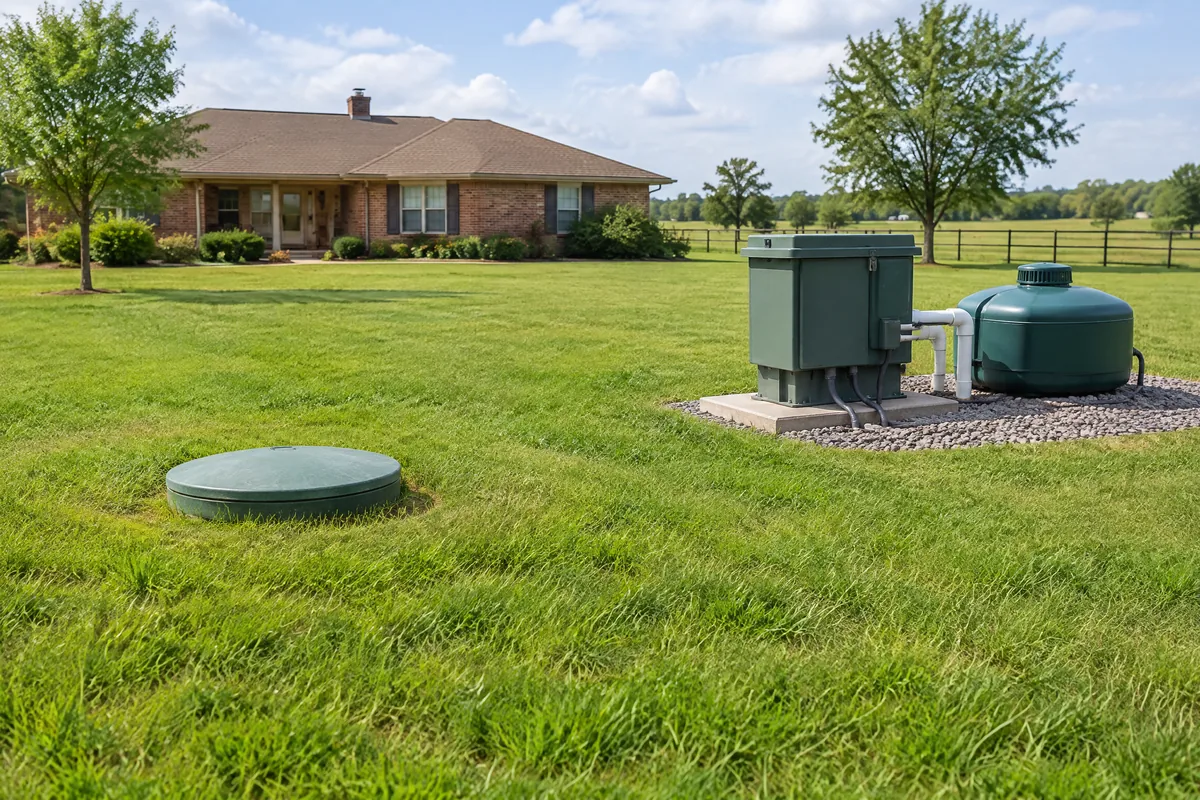
When a property is not connected to a municipal sewer, "septic" is not always enough information. Oklahoma homes may have conventional systems or aerobic treatment systems, and the inspection approach is different for each one.
Redbud keeps Conventional Septic System Inspections and Aerobic Septic System Inspections as separate services because the components and operating questions are not the same.
A conventional system relies on a tank and an absorption or lateral field. Much of that system is underground, so a realistic inspection has to be clear about what is and is not visible.
Redbud reviews available records and location information when they are available, observes accessible tank lids, risers, and visible components, and walks the absorption area looking for surface conditions that may indicate a concern.
That can include visible signs of leakage, saturation, backup, settlement, unusual drainage, or other field conditions.
The service does not include excavating buried lids or exposing concealed components. It also is not represented as a complete performance test of everything below grade. Those limitations are important because a buyer should know exactly what information the service can provide.
An aerobic treatment system has additional equipment that changes what the inspection needs to address. Redbud's aerobic inspection includes accessible treatment components, controls and alarms, observable aeration or pumping equipment, and dispersal operation when conditions allow.
The inspector may manually activate the spray or dispersal cycle when the system and conditions allow and observe accessible spray heads and field conditions.
Because the system includes mechanical components, maintenance history and current operation can be particularly useful to understand.
Redbud does not describe the aerobic inspection as a DEQ certification or regulatory-compliance determination. It is a visual, non-invasive inspection of accessible components and observed operation at the time of the inspection.
That distinction matters. A buyer can receive useful information about controls, alarms, operation, and visible field conditions without being told the inspection guarantees future performance or certifies the system for a government agency.
A septic inspection and a drain-line camera scope are related, but they are not identical services. The septic inspection focuses on the septic system itself. A Drain Line / Sewer Scope uses a camera to inspect accessible portions of the building's main drain line from a suitable access point.
For some properties, buyers choose both because they want information about the wastewater system outside the house and the concealed drain line carrying waste from the building.
Redbud's scheduler may offer shared septic choices that include a drain scope, and the client-services team can help explain which option fits the property.
If the listing simply says "septic," ask for more detail. Available records, seller information, service history, and visible equipment can help determine whether the property has a conventional or aerobic system.
That matters because choosing the wrong service can leave important components outside the intended inspection scope.
For buyers around Oklahoma City, Tulsa, and rural communities across the state, septic systems are often one of the most unfamiliar parts of a property. Redbud's approach is to keep the service definitions clear so clients know what is being inspected, what is accessible, and what limitations remain before they make a purchase decision.
If the seller has service records, pumping receipts, permits, or maintenance information, make those available before the inspection. Records do not replace field observations, but they can help identify the system, locate components, and explain previous work. That is particularly useful on acreage where lids, treatment components, or field areas are not obvious from the house itself.