
Preparing article…
Explore related services: View Redbud Sample Reports
A good inspection report should help you prioritize, not overwhelm you. Learn how RedBud organizes photos, findings, summaries, and follow-up for Oklahoma clients.
Explore related services: View Redbud Sample Reports
An inspection report can contain a lot of information, especially on an older home or a property with several specialty systems. The wrong way to use that report is to count every observation and assume the house with the longest report is automatically the worst one.
The better approach is to use the report as a map: start with the significant findings, understand the supporting evidence, then work through maintenance and lower-priority items in context.
That is how Redbud designs its reporting process.
A focused summary is useful because it keeps important observations from getting buried. But the summary is not the entire inspection.
If a roof issue, electrical concern, moisture condition, plumbing leak, HVAC problem, or structural observation appears in the summary, open the full system section and read the description that goes with it. Photos, videos, limitations, and recommendations provide the context that a one-line summary cannot.
The goal is to understand what the inspector saw, not just collect a list of bold headings.
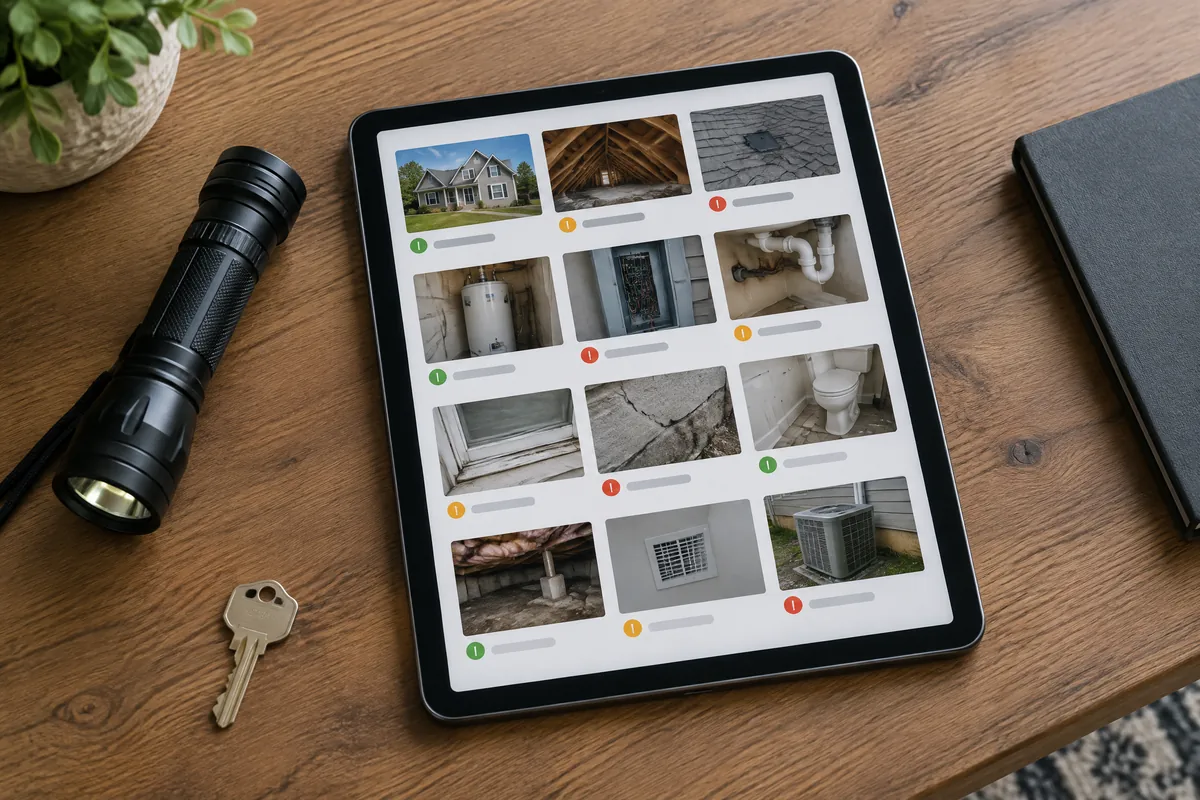
Redbud uses visual documentation so clients can connect written observations to the actual property. A useful photo shows where a condition is located or what the inspector is describing.
That can be especially helpful when you are reviewing the report after leaving the house. Instead of trying to remember which attic corner, electrical panel, plumbing fixture, or exterior wall the inspector discussed, you can go back to the image in the report.
Video can also be valuable for certain systems, particularly camera scopes or conditions where movement and sequence matter.
Not every observation has the same weight. Some findings may deserve prompt repair or specialist evaluation. Others are maintenance items that belong on a future ownership list.
The inspector's job is to document and explain the condition, not to decide whether you should buy the property. That decision depends on your budget, plans, tolerance for repairs, contract, and advice from the professionals involved in the transaction.
A first-time buyer may be worried by a long report because they have never seen one before. An experienced owner may recognize many items as normal maintenance. The report gives both clients the same underlying evidence so they can make their own decision.
Redbud's Spectora reports include a Repair Request Builder that can be used by buyers, clients, and agents. It allows selected findings to be organized into a cleaner follow-up document for repair or negotiation discussions.
The tool is useful because it lets you choose the observations that actually matter to your transaction instead of copying the entire inspection report into an email.
It should still be used thoughtfully. A report is not a shopping list where every maintenance note becomes a seller demand.
One of the most useful parts of a Redbud inspection is continued access to the team. If you do not understand a finding, ask. If a specialist's role is unclear, ask. If you want to know whether two observations may be related, ask.
Clear reporting should reduce confusion, not create it.
Redbud reports are mobile-friendly and can also be downloaded as a PDF, so clients can review the information on the device that works best for them. The full report remains available for deeper reading even after the transaction summary has served its immediate purpose.
A home inspection does not help much if the information is technically correct but impossible to navigate. The point of the report is to turn field observations into practical information.
For Oklahoma buyers, sellers, homeowners, and agents, that means being able to find the important item, see the evidence, understand the recommendation, and know what question to ask next. That is much more useful than simply being told a house has "a lot of findings."