
Preparing article…
Explore related services: Mold & Indoor Air Quality Testing
RedBud offers both Mold Inspection & Testing and Indoor Air Quality Testing for Mold. Learn the difference and which approach may fit an Oklahoma property.
Explore related services: Mold & Indoor Air Quality Testing
When someone is worried about mold, the first instinct is often to ask for an "air test." Sometimes that is appropriate. Other times, sampling without looking carefully at the building leaves out the most useful part of the investigation: moisture and visible conditions.
Redbud separates Mold Inspection & Testing from Indoor Air Quality Testing for Mold because they answer different questions.
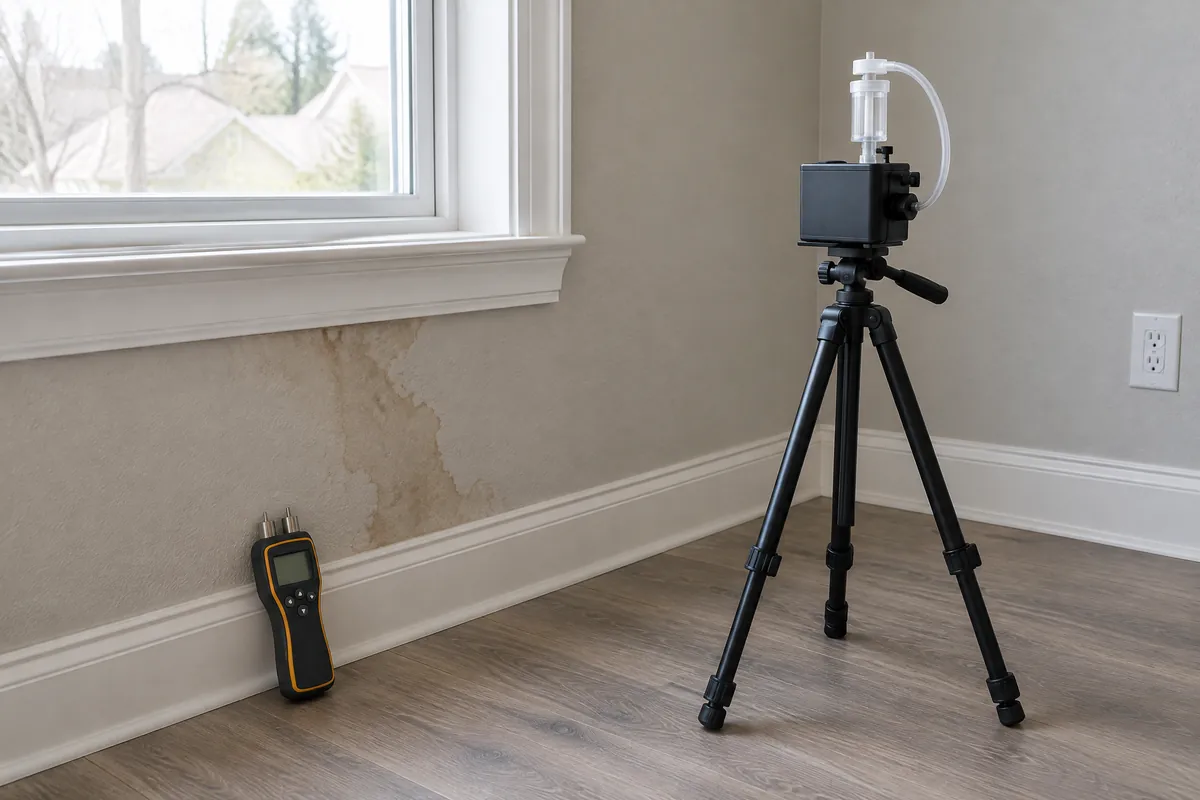
A mold inspection is a visual, non-invasive evaluation of accessible areas for mold-like growth, moisture concerns, and conditions that may support fungal growth. Redbud's IAC2-certified team can also use moisture measurements and targeted sampling when the situation and selected scope call for it.
That building-focused approach is important because mold is often a moisture story first. A stain, elevated moisture reading, plumbing leak, roof leak, ventilation issue, or history of water intrusion can give the inspector context that a laboratory result alone cannot provide.
Air, swab, or tape-lift samples may be collected when appropriate, but the inspection does not begin with the assumption that every property needs every type of sample.
Some clients want sampling without a visual mold inspection. Redbud offers that as a separate service: Indoor Air Quality Testing for Mold.
This can make sense when the client's question is specifically about airborne mold levels or when another professional has already identified the physical conditions and testing is the remaining need. The important point is that it should not be confused with a full visual mold investigation.
If you choose IAQ testing only, you are choosing sampling without the same building-wide visual mold inspection component.
Oklahoma homes deal with roof leaks, plumbing leaks, storm-driven rain, humidity changes, HVAC condensate, crawlspace moisture, and occasional water events from failed appliances or drainage problems. Two houses can have the same laboratory result for very different reasons.
That is why context matters. If there is visible staining below a roof penetration, a moisture concern around a bathroom, or a damp area near an HVAC component, the next step is different from a property where there are no visible moisture clues but the occupant still wants air sampling.
A laboratory sample can provide useful data about what was collected. It does not automatically identify where moisture is entering, whether a hidden area is affected, or what repair is needed.
Likewise, a visual inspection cannot answer every air-quality question. Good inspection work is about matching the service to the concern rather than pretending one method answers everything.
Redbud's approach is to keep those choices clear. The team can help clients decide whether the situation calls for a visual Mold Inspection & Testing service, testing-only Indoor Air Quality Testing for Mold, or another inspection focused on the system that may be contributing to the concern.
Both options can be added to a Redbud home inspection or scheduled as standalone services. That flexibility is useful during a real estate transaction because not every buyer has the same concerns.
A buyer who notices suspicious staining may want a focused mold inspection. A homeowner dealing with a persistent indoor-air concern may only want testing. Someone buying a slab home with suspected in-slab duct moisture may also be considering a duct scope as a separate service.
If you are unsure which direction fits the property, call Redbud's client-services team before scheduling. A five-minute conversation about what you are seeing can help you choose the service that actually answers your question instead of ordering a test simply because the word "mold" came up.