
Preparing article…
Explore related services: New Construction Inspections
A new home can still have incomplete work, installation defects, or workmanship concerns. Learn what RedBud looks for before or shortly after closing.
Explore related services: New Construction Inspections
A brand-new home should be finished correctly, but "new" and "problem-free" are not the same thing. New construction involves dozens of trades, hundreds of components, changing schedules, and work that often happens under tight deadlines. Most issues found during an independent new construction inspection are not dramatic. They are the kinds of things that are easier to address before closing than after boxes are unpacked.
That is why Redbud treats a new construction inspection as a broad whole-home inspection with a different emphasis, not as a quick cosmetic walk-through.
Buyers are naturally drawn to visible finishes: paint, flooring, cabinet doors, countertops, trim, and fixtures. Those details matter, but a professional inspection goes much farther.
Redbud reviews visible and accessible systems throughout the property, including roofing, exterior components, site drainage, electrical, plumbing, heating and cooling, attic areas, insulation, ventilation, interiors, garage components, and installed appliances within the inspection scope.
On a new home, the inspector is also paying attention to incomplete work, installation errors, workmanship defects, damage, and finish concerns that reasonably should be corrected before or shortly after closing.
A common question is: "Didn't the city already inspect this?"
Municipal inspections are important, but they are not the same service as an independent home inspection performed for the buyer. Code and permitting processes have their own purpose. A buyer-focused inspection looks at the home as a completed property and organizes visible findings in one place for the person who is about to own it.
That broader view can be especially useful when an issue crosses trade lines. Drainage, roofing, flashing, insulation, HVAC performance, and interior finishes can all interact. Looking at the property as one finished system can reveal concerns that are easy to miss when each trade is considered separately.
In Oklahoma, a new house immediately begins dealing with wind, heat, heavy rain, soil movement, and temperature changes. That makes good water management and proper installation especially important.
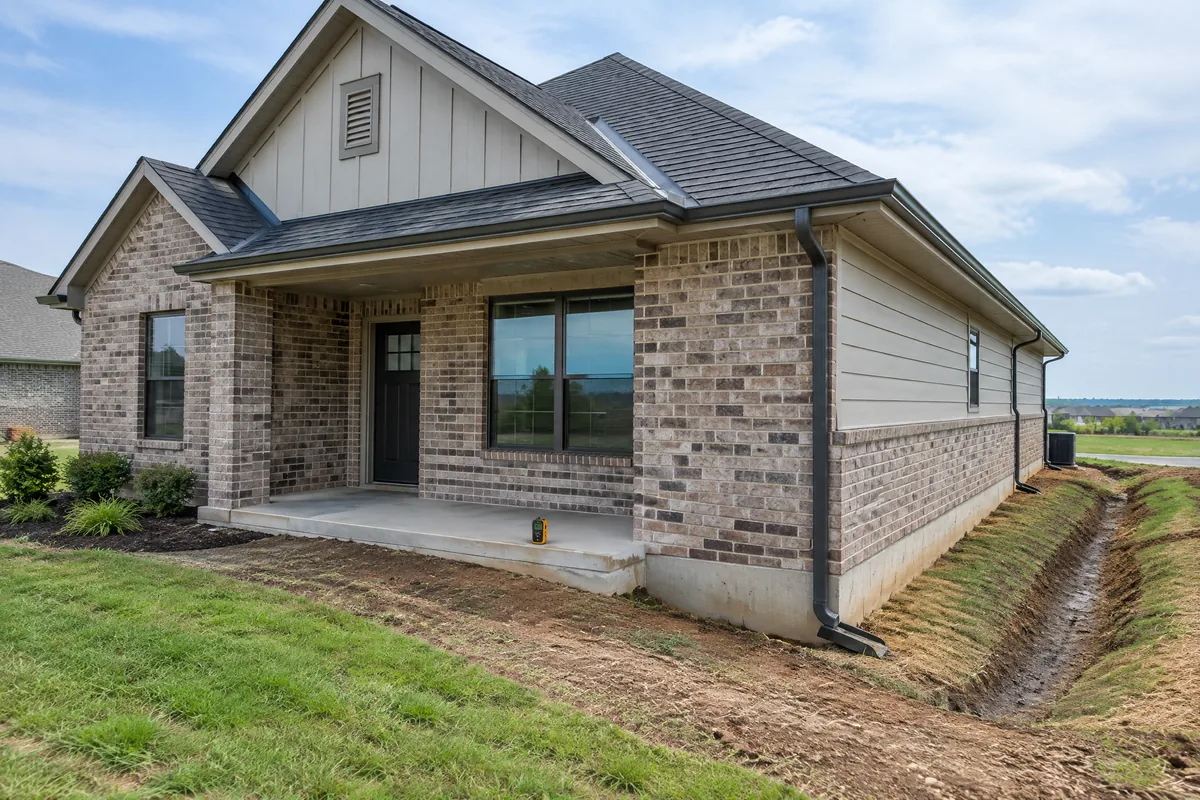
Grading, downspout discharge, roof drainage, exterior penetrations, attic ventilation, insulation, and visible foundation conditions are all worth reviewing before ownership begins. A new home may be structurally sound while still having small installation problems that create maintenance headaches later.
One of the best parts of a new construction inspection is the documentation. Redbud uses modern digital reporting with photographs and clear descriptions so buyers can see what was observed and where it was found.
That report can help organize conversations with the builder before closing. It also gives the homeowner a baseline for the first year of ownership. If a condition changes later, you have a record of what was visible at the time of the inspection.
A pre-closing inspection and an 11-month warranty inspection are not duplicates. The first evaluates the newly completed home before or around closing. The later inspection looks at the home after it has been occupied and exposed to a full cycle of weather and normal use.
By month 10 or 11, conditions such as movement, drainage behavior, HVAC issues, plumbing leaks, finish changes, or other first-year concerns may be easier to identify. Redbud offers 11-Month Warranty Inspections specifically for that stage.
For buyers in Oklahoma City, Edmond, Norman, Moore, Tulsa, Broken Arrow, and other Oklahoma communities, an independent new construction inspection is simply another layer of due diligence. You are buying a finished home, not a set of promises from individual trades. It makes sense to have someone evaluate the property from that same whole-home perspective.