
Preparing article…
Explore related services: Well, Flow, and Water Testing
Learn what RedBud's well inspection includes: accessible components, operation, calculated flow-rate testing, and standard coliform and E. coli water testing.
Explore related services: Well, Flow, and Water Testing
A private well adds a system to the property that many buyers have never owned before. Instead of relying on a municipal utility, the home depends on its own well, pressure equipment, plumbing connection, and water source. That makes the well worth evaluating separately from the standard home inspection.
Redbud's Well, Flow, and Water Testing service is designed to give buyers practical information about accessible equipment, observed operation, basic flow, and standard bacteria testing without pretending the inspection answers questions it does not.
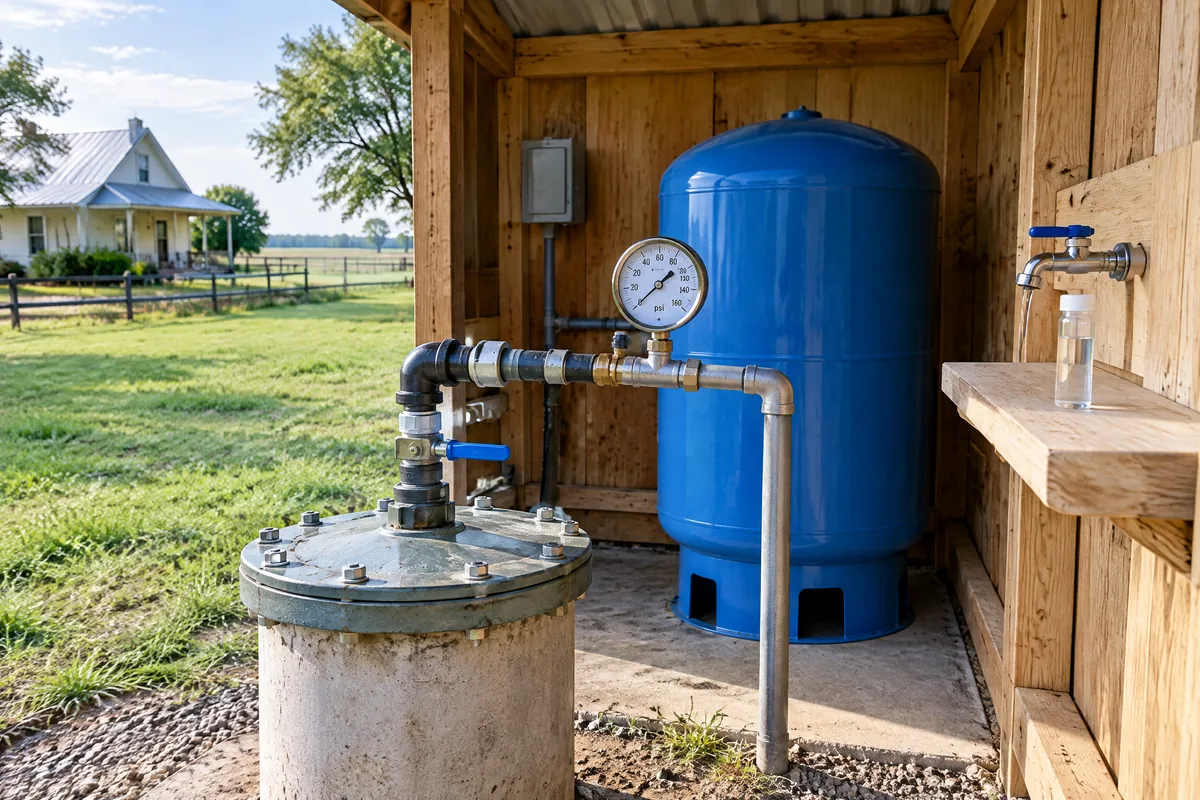
The inspection includes accessible well and pressure-system components. Depending on the property, that can involve visible equipment, controls, pressure components, piping connections, and other accessible parts of the system.
The inspector also observes system operation. The goal is to identify visible or operational concerns that deserve attention, not to dismantle concealed equipment or predict the life of a pump.
For buyers who have only lived on city water, this is useful because the equipment itself may be unfamiliar. The inspection report gives you a clearer picture of what is present and how it behaved during the inspection.
Redbud performs a basic calculated flow-rate test as part of the standard well inspection. That gives the client information about observed flow under the test conditions.
It is important not to overstate what that means.
A basic flow-rate test is not the same thing as a professional yield test, drawdown test, or production-capacity study. Those more specialized evaluations are designed to answer different questions about how much water a well can produce over time and how the water level responds to pumping.
Redbud keeps that distinction clear so a buyer does not walk away believing a short inspection test guarantees long-term well capacity.
The standard Redbud well inspection includes water testing for total coliform and E. coli. These tests provide information about bacterial conditions in the submitted sample.
That is valuable, but it should not be confused with a complete analysis of every possible contaminant. Different buyers, lenders, loan programs, or property conditions may call for additional testing.
If you have a specific water-quality concern, tell the client-services team before the appointment so you can determine whether the standard bacteria panel answers your question or whether another testing option is needed.
A house on a private well may also have a conventional or aerobic septic system, a long private drive, outbuildings, irrigation, or other features that make the property different from a typical in-town home.
That is one reason Redbud's client-services team asks about the actual property before scheduling. A buyer may need a home inspection, well and water testing, septic inspection, drain-line scope, termite/WDI inspection, or some combination of those services.
The goal is not to order everything available. It is to match the inspection scope to what the property actually has.
Owning a private well comes with maintenance responsibilities, but it does not have to feel like a black box. An inspection gives you a current look at accessible equipment, basic system operation, flow information, and standard bacterial test results.
For Oklahoma buyers moving from city utilities to acreage or rural property, that information is especially helpful before closing. You may still decide to have a well contractor perform additional testing or service, but you will be starting with documented observations instead of learning the system for the first time after you own it.