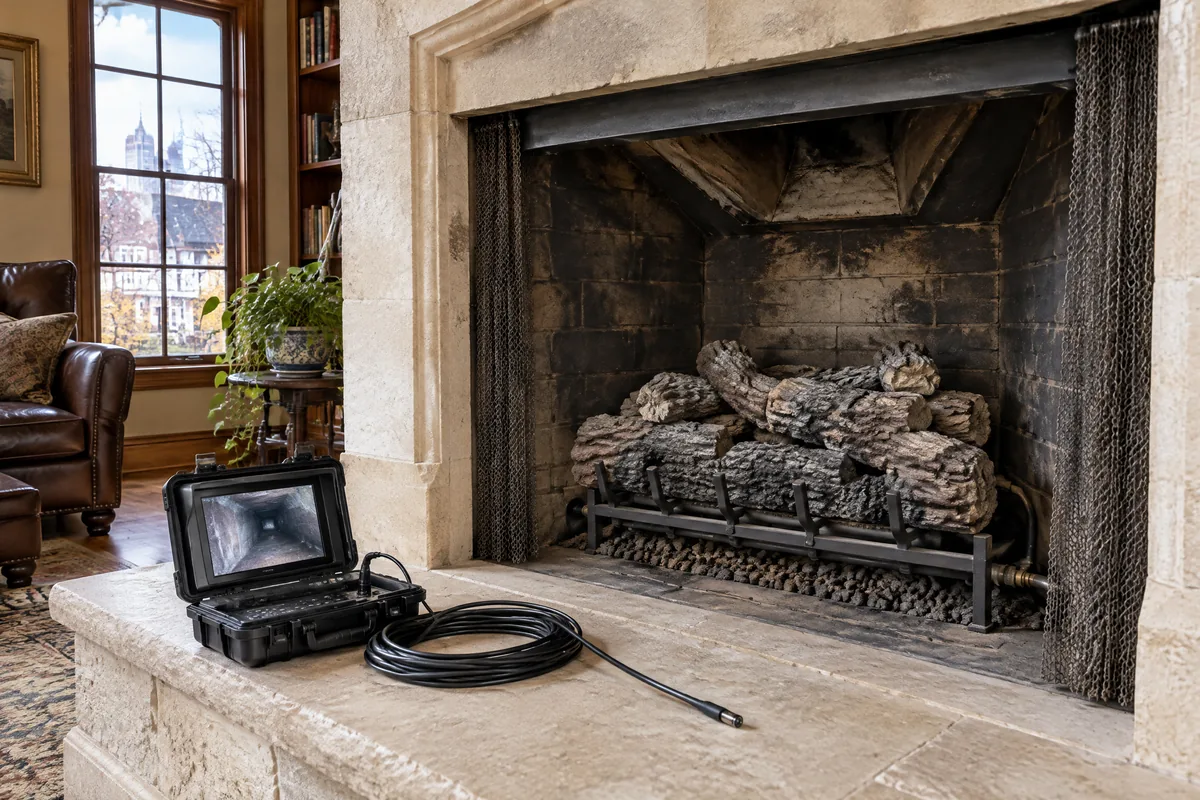
A Tulsa home listing that says “gas fireplace” leaves an important question unanswered: what equipment is actually installed? Gas logs inside a masonry firebox are not the same as a complete gas fireplace system. Before planning a first evening fire, identify the appliance and learn what its venting arrangement depends on.
For buyers arranging home inspections in Tulsa, this distinction helps turn a vague fireplace description into specific questions about equipment, installation history, and accessible chimney conditions.
Identify the gas logs before judging the chimney
Vented gas logs rely on a suitable fireplace and working chimney to carry combustion products outdoors. Vent-free logs are a different appliance category with their own installation requirements. The logs’ shape, a remote control, or the presence of a brick chimney does not establish which arrangement you have.
Ask for the model number and manufacturer’s instructions. A qualified professional can compare the identified equipment with the installation rather than guessing from its appearance. For example, the Majestic VWF vented-log manual specifies a working flue and a permanent damper opening. Those requirements illustrate why a gas supply alone does not settle the venting question; they are not instructions for adjusting your own fireplace.
Assemble a short fireplace history
Provide installation invoices, the appliance manual, previous chimney reports, and any records of liner work. Tell the inspector when the logs were added, if known, and whether the fireplace previously burned wood. Note reported operating concerns without lighting the appliance to reproduce them.
A dated invoice may identify the burner or installer, but it does not establish the current condition of the chimney. Likewise, “we never used it” describes occupancy history, not whether the system is suitable for use.
When a conversion has no paperwork
A wood-burning fireplace may retain its original chimney after gas logs are installed. New logs do not renew an older liner or document the compatibility of the completed arrangement. Missing records are uncertainty to investigate, not proof that someone installed the logs incorrectly.
The Chimney Safety Institute of America’s Level 2 guidance identifies changes in fuel or appliance type as reasons for a deeper inspection. Share the uncertain conversion history when booking so the specialist understands the question you need answered.
Connect camera findings to the installed system
Redbud Property Inspections’ Level 2 chimney inspection uses specialized video scanning to review the accessible flue-liner interior. The scope also considers the firebox, damper, smoke chamber, hearth, and visible chimney exterior and termination.
For a gas-log conversion, the useful connection is between the appliance’s venting needs and the observed chimney conditions. A camera may document visible liner gaps, deterioration, or deposits that cannot be evaluated from the room. It does not independently establish every requirement of the gas appliance’s installation.
Redbud’s scope does not include removing caps, crowns, connectors, or building components. An inaccessible section remains a limitation, not an assumed satisfactory condition. Our broader article on inspection before fireplace use explains the camera-assisted review beyond this gas-log question.
Separate observations from permission to operate
Read the report for what was identified, what was observed, and what still needs evaluation. Ask whether an unresolved concern involves the chimney, the gas appliance, or both. That distinction helps you arrange the appropriate qualified professional’s follow-up without treating one inspection as every service the fireplace might need.
A Level 2 inspection is not chimney cleaning, appliance repair, or a blanket safety certification. If there is a concern about the installation or venting, leave the fireplace unused until it has been evaluated. Do not alter the damper, rearrange logs, or light a test fire to resolve uncertainty yourself.
Keep winter indoor-air questions distinct
Vent-free gas combustion releases water vapor indoors, but window condensation alone cannot identify its source. The discussion of window condensation in Broken Arrow explains why moisture observations need context rather than an immediate mold conclusion.
A chimney inspection also does not measure radon. If you are coordinating separate winter appointments, Edmond radon-test preparation addresses the building conditions that service needs.
For your Tulsa property, schedule with Redbud Property Inspections and share the gas-log model, available records, and conversion questions before the visit.