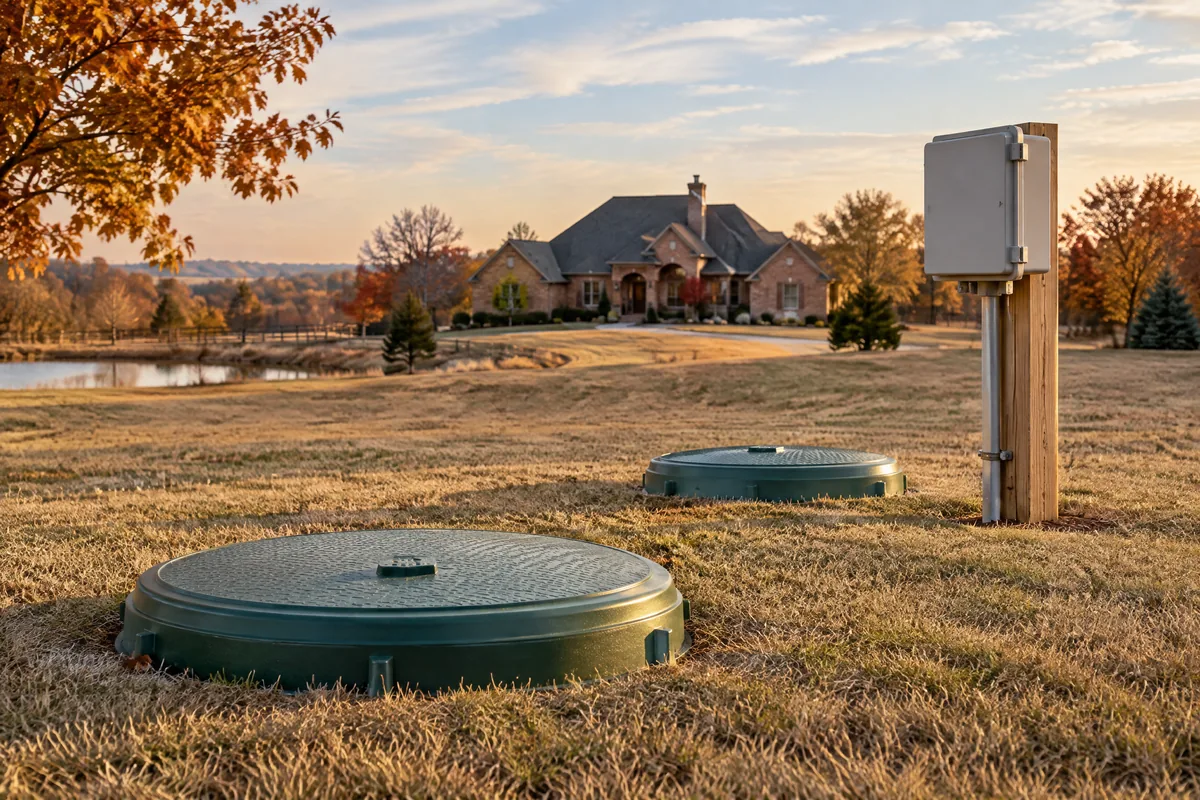
A quiet aerobic septic alarm panel at a Tuttle property is useful to observe, but it does not explain what happened last month. An alarm may have prompted a service visit, a component replacement, or a recommendation that remains unresolved. Those details can change the questions worth asking during an inspection.
Before your appointment, request the system's alarm history and service paperwork. The goal is not to assemble a perfect file. It is to connect present observations with documented events rather than treating silence as proof that every earlier concern disappeared.
A quiet panel cannot reconstruct earlier alarms
Aerobic systems use mechanical equipment to support wastewater treatment and dispersal. Redbud Property Inspections' aerobic septic inspection reviews accessible controls, alarms, aeration and pumping components, and dispersal operation when conditions allow. That visit documents what can be observed then.
It cannot recreate an intermittent alarm that stopped before the appointment. Nor does a quiet panel establish that the system performed normally throughout previous occupancy. Conversely, an old alarm does not automatically establish a current defect. A dated account helps distinguish a reported past event from a condition the inspector observes directly.
Ask the owner when the alarm occurred, whether it repeated, and what happened afterward. Include the approximate date, any light or message observed, and whether a service provider evaluated it. Existing photos or messages can help preserve details without asking anyone to trigger the alarm again.
Keep explanations separate from observations. “The alarm sounded after the outage” records a sequence; it does not prove the outage caused it. “The contractor replaced a pump” is more useful when supported by an invoice identifying the work and date.
Match each service visit to its follow-up
Gather maintenance reports, pumping receipts, component-replacement invoices, the manufacturer's manual, and the current provider's contact information. Look for recommendations as well as completed work. A receipt for a visit does not necessarily show that every recommended item was addressed.
The EPA's septic-care guidance recommends retaining maintenance records and notes that service reports should describe completed repairs and tank condition. Missing paperwork leaves a question to clarify, not an automatic finding of failure.
Preserve access without changing the system
For a Tuttle acreage appointment, share any available diagram showing the treatment components and dispersal area. Arrange authorized access to gates and keep stored items away from controls. Tell the inspector about inaccessible equipment before the visit. Do not open electrical enclosures, remove tank lids, or change settings yourself to prepare.
Do not silence or disable an alarm to make the property seem ready. If one is active, report it before the appointment and contact the maintenance provider. Oklahoma State University Extension directs owners to their maintenance provider when an alarm sounds rather than attempting repairs themselves.
Also identify where treated wastewater is dispersed. Accessible spray heads and visible field conditions provide context when operation is appropriate. Wet ground alone does not establish its source; weather, drainage, and observed operation matter.
Keep inspection and maintenance roles separate
An inspection supplies documented observations about accessible components and current operation. It is not a maintenance contract, repair visit, DEQ certification, or guarantee of future performance. A service agreement concerns ongoing responsibilities; ask the provider what visits, alarm responses, and exclusions it covers.
If records describe a recurring problem that is not reproduced during the inspection, discuss whether contractor evaluation is needed. The report can preserve that distinction instead of converting an unverified history into either reassurance or a diagnosis.
Bring records that fit this Tuttle property
Confirm the actual system before scheduling. Our conventional-versus-aerobic inspection overview explains why the scopes differ. If the property instead has conventional septic, the Guthrie guide to buried tank lids addresses a different access limitation.
For a property with a private well, keep well-service records separate. The Piedmont article on recent well disinfection explains why that history matters to sampling, not septic alarm interpretation.
For home inspections in Tuttle, send available records and known alarm concerns to Redbud Property Inspections before the visit. Schedule your inspection with the system type identified so the appointment addresses the equipment actually present.